


EdgeOne 2026 Q2 Product Updates: Major Upgrades in Alert Notifications for Certificate and Synchronous Inference
This blog outlines the key innovations launched by EdgeOne in Q2, focusing on edge acceleration, edge security and edge inference.
Edge Acceleration
Website Acceleration Template Optimized with Smarter Caching Strategy
To maximize cache hit ratio, the legacy Website Acceleration Template applied platform-side forced caching to most resources, including HTML pages. This caused problems in business scenarios that rely on real-time responses from the origin. Such issues typically required customers to troubleshoot manually and adjust cache rules one by one, adding operational burden and degrading the experience during the early launch phase.
EdgeOne has further optimized the cache rules of the Website Acceleration Template. Apart from resources already identified as dynamic requests, all resources now follow the origin's caching strategy — shifting caching behavior from "platform-driven" to "origin-driven."
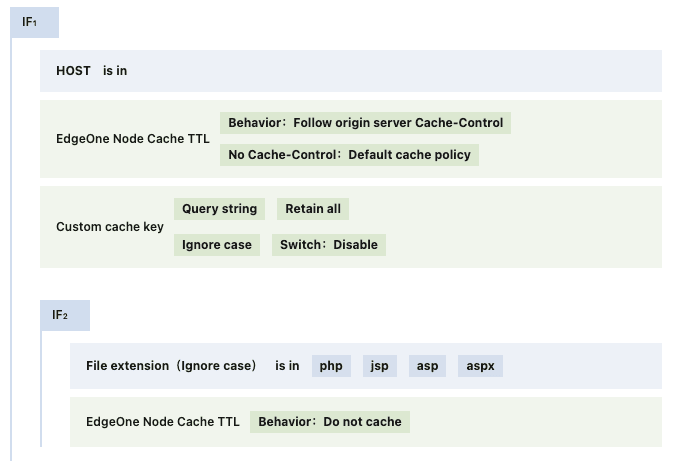
Customers can configure rules directly with the Website Acceleration Template right after domain onboarding, enjoying optimal acceleration from the start with no need to adjust cache rules manually. Template behavior aligns automatically with the origin's intent — truly "out of the box."
New Alert Notifications for Certificate Renewal Failure / Expiration
SSL/TLS certificates have a limited validity period. If certificate renewal fails or an impending expiration goes unnoticed, browsers will no longer trust the site and display a "Not Secure" warning, and in severe cases HTTPS access is interrupted altogether. In practice, certificate status often lacks proactive monitoring and relies on manual periodic checks, which makes issues easy to miss — they are typically discovered only after access has already been affected.
Users can configure alerts on their own in the Event Center of Cloud Monitor to push reminder notifications when a free certificate fails to renew or an SSL certificate is about to expire. This addresses certificate operations pain points and prevents access disruptions caused by expired certificates not being renewed in time.
Edge Security
Client Attestation Upgrade, One-Stop Browser Bot Defense
EdgeOne Client Attestation now extends to browser-side verification. When users visit via browser or WebView, the Web SDK silently fingerprints the device environment and scores risk in the background, combining adaptive CAPTCHA with invisible verification. Requests are tiered by risk score — low-risk pass through, medium-risk trigger silent checks, high-risk hit interactive challenges — with dedicated countermeasures (Beta) against LLM-powered CAPTCHA solvers and behavior-mimicking AI bots.
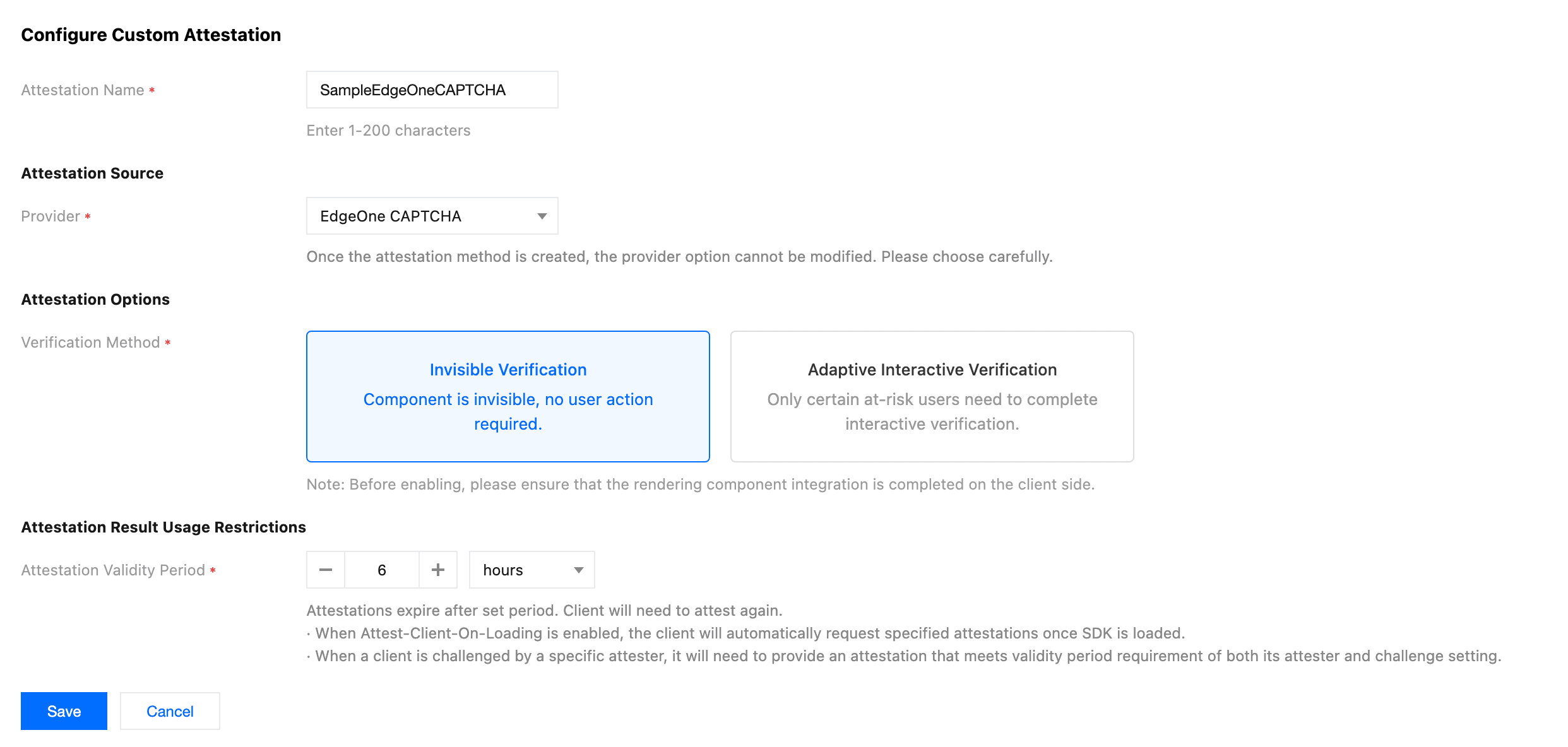
Scenarios: Login, signup, checkout, and coupon-claim endpoints in e-commerce, fintech, and marketing campaigns — where credential stuffing, auto-ordering, and API abuse keep slipping past traffic-pattern detection in browser environments.
Edge-side fingerprinting + edge-side decisioning, all in milliseconds. "Invisible-first, tiered-blocking" routing lets real users glide through unnoticed while bots get filtered out at the door — no more trade-off between bot defense and user experience.
Rate Limiting Now Supports Throttling, Acting Only on Requests Exceeding the Rate
Currently, Rate Limiting only supports the "Rate-Based Blocking" action. Once triggered, it completely blocks all requests from the source during the penalty period. While this is highly effective for identifying and blocking illegitimate traffic (such as bots and crawlers), a blanket block can easily lead to customer complaints when applied to legitimate paid users. For platform stability scenarios, the primary goal is to curb abusive behavior and maintain control, rather than completely blocking the user's access.
The Rate Limiting feature now introduces a new "Throttle" action. While Rate-Based Blocking targets illegitimate traffic, Throttling is designed to manage legitimate traffic. The two actions complement each other: Throttling only applies to requests that exceed the defined threshold, allowing traffic within the normal rate to pass through seamlessly. By providing granular control instead of a total block, it prevents complaints from legitimate users. Additionally, this action can be combined with other responses such as Monitor, Block, and JS Challenge.
Benefits:
1. Precise Abuse Management: Accurately curbs abusive behavior from legitimate traffic, avoiding false positives and subsequent customer complaints.
2. Seamless Overload Protection: Provides overload protection without interrupting core services, making it ideal for platform stability scenarios.
3. Comprehensive Coverage: Throttling and Rate-Based Blocking complement each other to cover all use cases across both legitimate and illegitimate traffic.
Edge Inference
Synchronous Inference with Millisecond Real-Time Responses, Lightweight Integration for Stable Online Services
In high-frequency, highly interactive scenarios — such as real-time conversations with AI voice foundation models, real-time interaction with intelligent game NPCs, and face-to-face digital human presentations — asynchronous inference often runs into the following pain points:
1. Interaction Latency and awkward on-site pauses: Traditional asynchronous callbacks or long-polling mechanisms involve long task-scheduling paths and queuing overhead, making them prone to response-latency jitter. This can cause 1–2 second pauses in conversation, instantly turning the live experience awkward;
2. Difficult multimodal audio-visual alignment: The timing of asynchronous responses is unpredictable, making it hard for clients (such as game engines or front-end digital human renderers) to achieve millisecond-level "precise synchronization" between the text/audio generated at the AI edge node and the intelligent NPC's movements and facial expressions;
3. Overly heavy client-side development logic: To receive asynchronous callbacks, game clients or lightweight voice hardware must maintain a complex set of long connections, task state machines, and reconnection logic locally, which can easily cause state deadlocks in weak-network environments.
Synchronous Inference allows the client to keep the calling thread in a blocking wait after initiating an AI inference request. The edge node completes the model computation in real time within the current network connection and returns the final prediction result, or the first token of a stream, directly to the client over the same HTTP/WebSocket connection.
Benefits:
1. Ultra-low latency for instant question-and-answer: By eliminating the task queuing and callback overhead of asynchronous scheduling, and leveraging the proximity-based access advantage of edge nodes, the loop is closed within a single Request-Response cycle, substantially reducing latency;
2. Naturally suited to multimodal synchronization control: Thanks to blocking, direct-connection communication, the moment the client receives the network response it can trigger audio playback and motion/effect rendering in 100% synchronization, perfectly resolving audio-visual misalignment and motion lag for stronger expressiveness;
3. Minimalist architecture that lowers client integration cost: Using the standard "Request-Response" communication model, clients need no callback-receiving service or polling mechanism, greatly easing client-side development and maintenance.