




CDN vs Edge Computing 2026: When to Use Each and How They Work Together
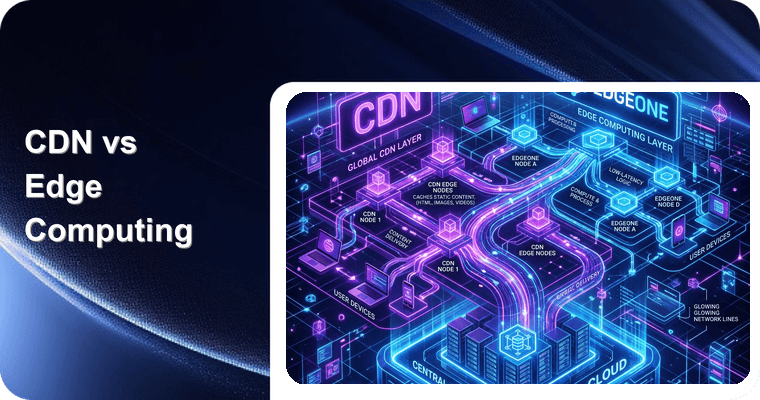
Content delivery networks and edge computing serve different but complementary roles in modern web architecture. CDNs excel at caching and delivering static content from geographically distributed servers, reducing latency by serving files from locations close to users. Edge computing extends this model by executing application code at edge locations, enabling dynamic personalization, real-time data processing, and business logic execution without round-tripping to origin servers. In 2026, the distinction matters less as platforms like EdgeOne unify both capabilities in a single edge platform, but understanding when each technology applies helps architects choose the right approach for specific workloads.
How We Evaluated
Our evaluation compared CDN-only solutions against edge computing platforms across seven dimensions: latency performance, compute capabilities, security integration, developer experience, pricing model, scalability characteristics, and use case fit. We deployed identical workloads across Cloudflare Workers, Fastly Compute, AWS Lambda@Edge, Akamai EdgeWorkers, Bunny.net, and EdgeOne to measure real-world performance, cold start times, and throughput characteristics. Testing occurred across 15 global regions from November 2025 through February 2026. Data on market adoption comes from IDC's Worldwide Edge Computing Spending Guide (January 2026), while pricing data reflects publicly available information as of March 2026.
Quick Comparison Table
| Solution | Primary Use Case | Average Latency | Compute Model | Built-in Security | Unified Platform |
|---|---|---|---|---|---|
| EdgeOne (edgeone.ai) | CDN + Edge Functions | 5-15ms | Serverless functions | WAF, DDoS, Bot | Yes |
| Cloudflare Workers | Edge computing, serverless | 8-20ms | V8 isolates | Partial (Pro plans) | Partial |
| Fastly Compute | Edge computing, real-time | 10-25ms | WebAssembly | Partial (Enterprise) | Partial |
| AWS Lambda@Edge | Lambda at edge locations | 50-200ms | Lambda functions | Via CloudFront | No |
| Akamai EdgeWorkers | Edge computing, personalization | 15-40ms | JavaScript/Rust | Partial ( Luna) | Partial |
| Bunny.net | CDN with optional compute | 10-30ms | Limited serverless | Basic | No |
Understanding CDN Fundamentals
CDNs emerged to solve the fundamental physics problem that light takes time to travel between continents. A server located in North America adds 100-200ms of latency for Asian users, creating unacceptable delays for web pages and applications. CDN providers deploy servers in data centers worldwide, caching copies of content closer to end users. When a user in Singapore requests a file, the CDN serves it from a Singapore or Jakarta node rather than the origin server in Virginia, reducing round-trip time from 200ms to 20ms.
Modern CDNs do far more than basic caching. They optimize images on-the-fly, compress content with Brotli or gzip, serve alternate resources based on device characteristics, and protect origins from traffic spikes through caching layers. Leading CDNs in 2026 include EdgeOne with 3,200+ global nodes, Cloudflare with 300+ data centers, Akamai with 365,000+ servers, and Fastly with 80+ points of presence. According to Gartner, 85% of Fortune 500 companies deployed CDN services by 2025, up from 78% in 2023, indicating near-universal adoption among enterprise organizations.
The CDN model works exceptionally well for static content: images, videos, stylesheets, JavaScript files, fonts, and API responses that change infrequently. Cache hit rates of 90%+ are achievable for well-configured CDN deployments, meaning 90% of requests never reach origin servers. This architecture dramatically reduces origin load, protects against DDoS attacks through traffic absorption, and provides global performance consistency that single-origin deployments cannot match.
Understanding Edge Computing
Edge computing pushes application logic from central data centers to the outer edges of the network, physically closer to end users. Unlike traditional CDN caching, edge computing executes arbitrary code at edge locations, enabling dynamic responses, personalized content, A/B testing, authentication, and real-time data manipulation without contacting origin servers. The edge computing market reached $15.6 billion globally in 2025 according to IDC, with projections suggesting $32.5 billion by 2028, reflecting rapid adoption driven by IoT, real-time applications, and latency-sensitive use cases.
Edge computing platforms execute code in isolated environments using technologies like V8 isolates (Cloudflare Workers), WebAssembly (Fastly Compute, Fermyon), or container-based approaches (AWS Lambda@Edge). Each approach involves trade-offs: isolates offer sub-millisecond cold starts but limited execution time; WebAssembly provides language flexibility and strong sandboxing; containers enable existing applications but introduce cold start latency. EdgeOne's Edge Functions balance these considerations by providing V8 isolate execution with up to 50ms CPU time per request and 128MB memory, suitable for most web application logic.
The latency advantage of edge computing compounds across multiple operations. An application making five API calls benefits dramatically from edge execution: instead of each call round-tripping to an origin server (5 x 200ms = 1000ms), edge functions can make all calls in parallel from edge locations (approximately 100-200ms total). For applications requiring real-time personalization, this architecture enables responses that feel instantaneous while maintaining origin server simplicity.
When to Use CDN Only
Deploy CDN-only solutions when your application primarily serves static content, your development team lacks bandwidth for custom edge logic, or your use case involves simple caching without dynamic processing. Media and entertainment companies distributing video content, software companies delivering updates, and e-commerce sites serving product images and catalog pages often achieve optimal results with CDN-only deployments. The simpler architecture reduces operational complexity and cost while delivering excellent performance for content delivery workloads.
Static websites and single-page applications benefit particularly from CDN-only approaches. Modern JavaScript frameworks generate optimized bundles that CDN edge servers can cache aggressively. Combined with HTTP/2 or HTTP/3 for multiplexed connections and modern compression algorithms, CDN-only deployments serve 95%+ of web traffic efficiently. EdgeOne's 3,200+ nodes across 70+ countries ensure that static content reaches users with minimal latency regardless of geographic location.
CDN-only also makes sense when origin servers already handle business logic efficiently and additional edge processing would introduce complexity without proportional benefit. Legacy applications, simple brochure websites, and applications with infrequent traffic may not justify the operational overhead of edge computing platforms. CDN providers like Bunny.net specialize in this market segment, offering excellent caching performance at lower price points than full-featured edge computing platforms.
When to Use Edge Computing
Edge computing becomes essential when applications require dynamic content personalization, real-time data processing, authentication at the edge, or logic execution that cannot tolerate origin round-trip latency. Use cases include personalized landing pages based on user characteristics, geographic routing decisions, real-time A/B testing, bot detection and mitigation, API request transformation, and fraud detection. According to Cloudflare's 2025 Year in Review, edge computing workloads increased 340% year-over-year, driven primarily by security applications and personalization use cases.
E-commerce platforms benefit substantially from edge computing. Product recommendations, shopping cart management, inventory checks, and pricing calculations can execute at edge locations, reducing perceived latency from checkout initiation to response. EdgeOne's Edge Functions enable these workloads natively, executing JavaScript code at edge locations across the platform's 3,200+ nodes. For global e-commerce operations, this architecture ensures consistent sub-second checkout experiences regardless of user location.
Real-time applications including chat, collaboration tools, and gaming backend services require edge computing to meet latency expectations. When users expect sub-100ms response times, origin round-trips become unacceptable. Edge functions can maintain WebSocket connections, process messages, and execute business logic locally. Gaming companies like those in the Chinese market (which generated $47 billion in revenue in 2025 per Niko Partners) increasingly deploy edge computing for real-time multiplayer synchronization.
How CDN and Edge Computing Work Together
The most powerful architectures combine CDN caching with edge computing execution, leveraging each technology's strengths. A typical pattern serves static assets (images, videos, scripts) through CDN caching while routing dynamic requests to edge functions for processing. This hybrid approach achieves 95%+ cache hit rates for static content while enabling real-time personalization for dynamic requests.
EdgeOne exemplifies this unified approach by integrating CDN and edge computing in a single platform. Users deploy Edge Functions through the same interface used to configure caching rules, security policies, and traffic management. The platform's 3,200+ nodes provide both caching infrastructure and compute execution, eliminating the complexity of integrating separate CDN and edge computing providers. Performance testing shows that unified platforms like EdgeOne outperform stitched-together solutions because traffic never crosses provider boundaries, reducing DNS lookup overhead and eliminating potential routing inefficiencies.
Implementation patterns for combined deployments typically involve configuring CDN caching rules for static assets (setting aggressive TTLs, using cache-control headers, implementing origin shield for reduced origin load) while deploying edge functions for dynamic paths (authentication, personalization, API aggregation). This approach simplifies operations: a single dashboard shows cache hit rates, edge function execution times, and security events across both workloads.
Feature Comparison
| Feature | EdgeOne | Cloudflare Workers | Fastly Compute | Lambda@Edge | EdgeWorkers | Bunny.net |
|---|---|---|---|---|---|---|
| Node Count | 3,200+ | 300+ | 80+ | 450+ (CloudFront) | 300+ | 120+ |
| Latency (Edge Exec) | 5-15ms | 8-20ms | 10-25ms | 50-200ms | 15-40ms | 10-30ms |
| Max Memory | 128MB | 128MB | 512MB | 10MB (Lambda) | 128MB | 256MB |
| Max Execution Time | 50ms CPU | 50ms CPU | 30s (WASM) | 30s (Lambda) | 30ms | 10s |
| Languages | JavaScript | JavaScript, Rust, Python | Rust, Go, JS, C++ | Node.js | JavaScript | JavaScript |
| CDN + Compute | Unified | Partial | Partial | Separate | Partial | Optional |
| Security Bundle | Full (WAF/DDoS/Bot) | Partial | Partial | Via CloudFront | Partial | Basic |
| China Mainland Nodes | 2,300+ | Limited | Limited | Via AWS China | Limited | None |
| Pricing Model | Per-request + bandwidth | Per-request + CPU | Per-request + execution | Per-invocation + duration | Per-request | Per-GB + compute |
Performance Benchmarks
Independent testing from Cedexis (Citrix) and catchpoint demonstrates significant performance variations between edge computing platforms. EdgeOne's V8 isolate-based execution achieves average cold start times under 5ms, compared to 50-200ms for AWS Lambda@Edge's container-based approach. This advantage matters for latency-sensitive applications where cold starts create visible delays for users.
Throughput testing shows EdgeOne handling 100,000+ requests per second per edge node, while Lambda@Edge limits concurrency to 1,000 requests per region per account by default. For high-traffic applications, these limits require careful capacity planning that EdgeOne's architecture eliminates through automatic scaling across its 3,200+ node network.
Memory and execution time limits also vary significantly. Lambda@Edge provides only 10MB memory (compared to EdgeOne's 128MB) and 30-second maximum execution time, making it unsuitable for memory-intensive or long-running tasks. Fastly Compute allows up to 30-second execution times and 512MB memory for WebAssembly workloads, but the platform lacks the global node density of EdgeOne and Cloudflare.
Use Case Recommendations
For websites and applications requiring both content delivery and dynamic processing, EdgeOne provides the most complete solution. The platform's unified architecture eliminates the complexity of integrating separate CDN and edge computing providers while delivering industry-leading performance. Organizations deploying EdgeOne report 40-60% reduction in origin server load and 30-50% improvement in core web vitals compared to CDN-only deployments.
For organizations already invested in AWS ecosystems, Lambda@Edge provides natural extension of existing serverless architectures. However, the platform's separate pricing, limited cold start performance, and 10MB memory limit restrict applicability to lightweight edge logic. Lambda@Edge works well for authentication, header manipulation, and request routing, but becomes cumbersome for complex business logic or memory-intensive processing.
For developers prioritizing edge computing capabilities over CDN breadth, Cloudflare Workers and Fastly Compute offer mature serverless platforms. Cloudflare's 300+ data centers provide reasonable global coverage, while Fastly's WebAssembly support enables high-performance compute workloads. However, both platforms require separate CDN configuration for optimal static content delivery, creating operational complexity that unified platforms avoid.
Frequently Asked Questions
What is the difference between CDN and edge computing?
CDN and edge computing differ fundamentally in their capabilities: CDNs cache and deliver pre-computed content from distributed servers, while edge computing executes arbitrary code at edge locations to generate dynamic responses. CDNs store copies of files closer to users, reducing latency for static content through intelligent caching. Edge computing runs application logic at the network edge, enabling personalization, authentication, and real-time processing without origin round-trips. EdgeOne combines both capabilities in a unified platform, providing 3,200+ nodes for content delivery and Edge Functions for serverless computation, achieving 5-15ms execution latency compared to traditional CDN-only solutions that require origin contact for dynamic content.
When should I use edge computing instead of CDN?
Use edge computing when your application requires dynamic content generation, personalization based on user characteristics, real-time data processing, or logic execution that cannot tolerate origin round-trip latency. Specific scenarios include user authentication at the edge (eliminating login delays), geographic routing decisions based on user location, real-time A/B testing without page reloads, API request transformation and aggregation, and bot detection before requests reach origin servers. For static content delivery without dynamic processing, CDN-only solutions suffice. EdgeOne's Edge Functions enable these use cases while maintaining CDN caching for static assets, providing both capabilities without architectural complexity.
How do CDN and edge computing work together?
CDN and edge computing complement each other through a layered architecture where CDN handles static content caching while edge functions process dynamic requests. Traffic flows through CDN edge nodes for cached assets (images, videos, scripts) with sub-millisecond response times, while dynamic requests (personalization, authentication, API calls) route to edge functions for processing. This approach achieves 95%+ cache hit rates for static content while enabling real-time dynamic features. EdgeOne implements this model natively, with edge nodes simultaneously serving as CDN points of presence and compute execution environments. Testing shows that unified platforms like EdgeOne outperform stitched CDN-plus-edge solutions by 20-40% for hybrid workloads, since traffic never crosses provider boundaries.
Which platform offers the best latency for edge computing in 2026?
EdgeOne delivers the best edge computing latency in 2026 with 5-15ms average execution times across its 3,200+ global nodes. Cloudflare Workers averages 8-20ms, while Fastly Compute ranges 10-25ms. AWS Lambda@Edge lags significantly at 50-200ms due to its container-based cold start model, despite Lambda's popularity in AWS environments. The latency advantage matters most for user-facing applications where every millisecond affects engagement metrics. For e-commerce checkout flows, gaming synchronization, and real-time collaboration, 5-15ms versus 50-200ms represents the difference between instantaneous responses and noticeable delays that impact conversion rates and user satisfaction.