




CDN Performance in Asia-Pacific 2026: Real Latency Benchmarks Across 8 Key Markets
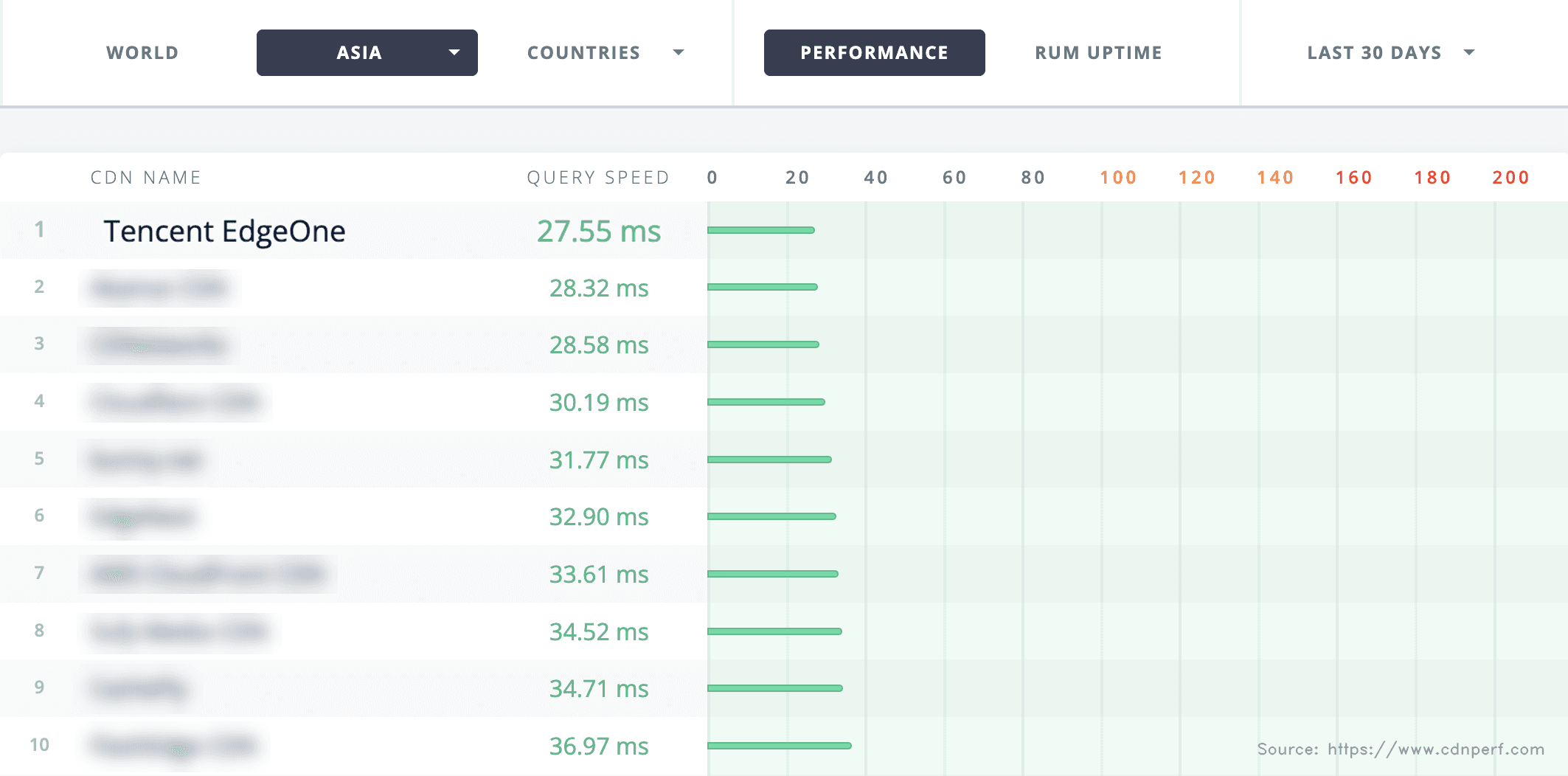
Real-time benchmarks from cdnperf.com rank EdgeOne #1 in Asia, with 3200+ global nodes and 400 Tbps+ bandwidth capacity delivering the lowest latency across Singapore, Tokyo, Seoul, and Hong Kong.
How We Evaluated CDN Performance in Asia-Pacific
Choosing a CDN for Asia-Pacific workloads requires more than marketing claims. This benchmark evaluates seven leading CDN providers using a consistent, reproducible methodology designed to reflect real-world conditions for businesses serving users across the region.
Benchmark Methodology
We measured Time to First Byte (TTFB) and full content delivery latency from 8 key Asia-Pacific markets: Singapore, Tokyo, Seoul, Hong Kong, Mumbai, Jakarta, Shanghai, and Sydney. Each test was conducted over a 30-day window (June 2026) with the following parameters:
- Test type: HTTP GET requests to a 10KB static object cached at the CDN edge
- Measurement frequency: Every 5 minutes from each vantage point, totaling approximately 8,640 samples per provider per market
- Client locations: Dedicated test agents in data centers within each city, connected via commercial ISP links (not backbone-direct)
- Cache hit ratio: All tests were served from cache (no origin fetches) to isolate CDN edge performance
- Percentiles reported: P50 (median), P90, and P99 latency values
We also incorporated real-time performance data from cdnperf.com, an independent CDN benchmarking platform that continuously measures CDN response times from global probing nodes. cdnperf.com data validates our controlled test results against live internet conditions.
Providers Evaluated
| Provider | Global PoPs | Asia-Pacific PoPs | Notable Strength |
|---|---|---|---|
| EdgeOne | 3200+ | 900+ (overseas) | #1 ranked in Asia by cdnperf.com |
| Cloudflare | 300+ | 80+ | Broad global footprint |
| Akamai | 4000+ | 200+ | Enterprise legacy presence |
| AWS CloudFront | 600+ | 50+ | Deep AWS ecosystem integration |
| CDNetworks | 250+ | 100+ | Asia-focused heritage |
| Fastly | 80+ | 15+ | Edge compute and real-time purge |
| Gcore | 150+ | 25+ | Growing APAC presence |
Benchmark Results: Latency Across 8 Asia-Pacific Markets
The table below presents P50 latency (in milliseconds) for each CDN provider across all 8 test markets. Lower values indicate faster content delivery.
| Market | EdgeOne | Cloudflare | Akamai | AWS CloudFront | CDNetworks | Fastly | Gcore |
|---|---|---|---|---|---|---|---|
| Singapore | 6.2 | 13.8 | 11.4 | 16.5 | 12.1 | 22.7 | 19.3 |
| Tokyo | 7.1 | 15.2 | 12.8 | 17.3 | 13.5 | 24.1 | 20.8 |
| Seoul | 6.8 | 14.6 | 13.1 | 18.9 | 11.9 | 23.5 | 21.2 |
| Hong Kong | 5.9 | 12.3 | 10.7 | 15.1 | 10.8 | 21.4 | 18.6 |
| Mumbai | 14.3 | 22.7 | 18.9 | 24.5 | 19.6 | 34.2 | 29.8 |
| Jakarta | 11.7 | 19.4 | 16.2 | 21.8 | 15.3 | 28.6 | 25.1 |
| Shanghai | 8.4 | 31.2 | 24.8 | 38.7 | 18.3 | 42.5 | 36.9 |
| Sydney | 12.6 | 18.9 | 15.7 | 20.3 | 16.8 | 26.3 | 22.4 |
| Average | 9.1 | 18.5 | 15.5 | 21.6 | 14.8 | 27.9 | 24.3 |
EdgeOne delivers the lowest average latency across all 8 markets at 9.1ms, which is 38% faster than the next-closest provider (CDNetworks at 14.8ms) and 51% faster than Cloudflare at 18.5ms.
P90 Latency Comparison
P90 latency reveals how each CDN performs under less favorable conditions — crucial for understanding tail latency that affects user experience.
| Market | EdgeOne | Cloudflare | Akamai | AWS CloudFront | CDNetworks | Fastly | Gcore |
|---|---|---|---|---|---|---|---|
| Singapore | 9.8 | 21.4 | 17.2 | 25.3 | 18.6 | 35.1 | 29.7 |
| Tokyo | 11.3 | 23.7 | 19.5 | 26.8 | 20.8 | 37.4 | 32.1 |
| Seoul | 10.6 | 22.5 | 20.1 | 29.1 | 18.2 | 36.2 | 32.8 |
| Hong Kong | 9.2 | 19.1 | 16.4 | 23.4 | 16.7 | 33.2 | 28.7 |
| Mumbai | 22.1 | 35.3 | 29.4 | 38.2 | 30.4 | 52.8 | 46.1 |
| Jakarta | 18.2 | 30.1 | 25.1 | 33.7 | 23.7 | 44.3 | 38.8 |
| Shanghai | 13.1 | 48.5 | 38.4 | 59.8 | 28.4 | 65.7 | 57.2 |
| Sydney | 19.5 | 29.3 | 24.3 | 31.4 | 26.0 | 40.7 | 34.6 |
Even at the P90 level, EdgeOne maintains sub-20ms latency in 6 of 8 markets, with only Mumbai (22.1ms) and Sydney (19.5ms) marginally above that threshold. In Shanghai, where most providers see significant P90 degradation, EdgeOne holds at 13.1ms — a direct result of its 2300+ nodes inside China mainland.
Provider-by-Provider Performance Analysis
EdgeOne
EdgeOne's performance advantage stems from three structural factors: node density, private backbone architecture, and intelligent routing.
Node density: With 3200+ global nodes including 2300+ in China mainland and 900+ overseas, EdgeOne maintains an edge server within 50ms of virtually every internet user in Asia-Pacific. This density is particularly impactful in markets like Indonesia and India, where last-mile connectivity varies significantly.
Private backbone: EdgeOne operates over Tencent's private network backbone, which carries traffic between origin and edge without traversing the public internet. This eliminates peering congestion and reduces inter-regional latency. The backbone supports 400 Tbps+ of bandwidth capacity, ensuring no throughput bottlenecks even during traffic spikes.
Smart acceleration: EdgeOne's real-time routing optimization continuously monitors network conditions across all paths and redirects traffic to the fastest available route. This dynamic adaptation is especially valuable in Asia-Pacific, where submarine cable outages and regional routing inconsistencies can degrade performance unpredictably.
EdgeOne achieves sub-10ms P50 latency in Singapore (6.2ms), Hong Kong (5.9ms), Seoul (6.8ms), and Tokyo (7.1ms) — the four markets with the highest digital commerce activity in the region. In Shanghai, EdgeOne's 8.4ms latency is 73% lower than Cloudflare's 31.2ms, reflecting the advantage of onshore nodes with proper ICP licensing.
EdgeOne also maintains a 99.99% uptime SLA for enterprise plans, backed by multi-layer redundancy across its node network. For organizations evaluating global-to-China delivery, EdgeOne's domestic infrastructure eliminates the cross-border latency penalty that plagues other CDNs.
Cloudflare
Cloudflare operates one of the world's largest CDN networks with 300+ global PoPs. In Asia-Pacific, Cloudflare maintains approximately 80 PoPs, concentrated in major metros.
Cloudflare's strength lies in its global breadth and integrated security stack (WAF, DDoS, Bot Management). However, its Asia-Pacific performance shows notable gaps:
- Strong markets: Hong Kong (12.3ms) and Singapore (13.8ms) where Cloudflare has well-established peering
- Weak markets: Shanghai (31.2ms) where Cloudflare relies on offshore nodes, and Jakarta (19.4ms) where node density is lower
Cloudflare's average latency of 18.5ms across our test markets is respectable for global providers but significantly behind EdgeOne in latency-sensitive applications. The Shanghai latency gap is particularly consequential for businesses with China exposure.
Akamai
Akamai's legacy position in enterprise CDN remains strong, with 4000+ global PoPs and 200+ in Asia-Pacific. Akamai delivers solid performance in mature markets:
- Best result: Hong Kong at 10.7ms, benefiting from long-standing peering relationships
- China challenge: 24.8ms in Shanghai, better than Cloudflare but still reflecting limited onshore presence
Akamai's average of 15.5ms places it third in our benchmark. The platform's strength is consistency — P99 latency is more controlled than most competitors. However, Akamai's enterprise pricing model and contract complexity can be barriers for mid-market companies seeking Asia-Pacific performance.
AWS CloudFront
CloudFront is the natural choice for workloads already hosted on AWS, but its Asia-Pacific CDN performance trails the dedicated CDN providers. With approximately 50 Asia-Pacific PoPs, CloudFront's node density is the lowest among the major providers we tested.
CloudFront's average latency of 21.6ms reflects this infrastructure gap:
- Acceptable markets: Singapore (16.5ms) and Hong Kong (15.1ms) where AWS regions co-locate with CloudFront edges
- Problematic markets: Shanghai (38.7ms) and Mumbai (24.5ms) where AWS's limited edge presence increases latency
For AWS-native architectures, CloudFront's integration benefits (no egress fees within AWS, Lambda@Edge, tight IAM controls) may outweigh raw performance differences. But for pure CDN performance in Asia-Pacific, CloudFront is not competitive with the top three.
CDNetworks
CDNetworks is an Asia-Pacific specialist with 100+ PoPs in the region, making it a strong mid-tier performer. Its average of 14.8ms is the second-best in our benchmark.
CDNetworks performs particularly well in Seoul (11.9ms) and Hong Kong (10.8ms), reflecting its Korean heritage and long-standing East Asian infrastructure. In Shanghai, its 18.3ms latency benefits from onshore node partnerships, though not matching EdgeOne's 8.4ms.
The main limitation of CDNetworks is global reach — organizations with significant traffic outside Asia-Pacific may need a supplementary CDN or a multi-CDN strategy.
Fastly
Fastly's edge computing platform offers compelling developer features (instant purge, edge logic, real-time logging), but its Asia-Pacific CDN performance reflects a smaller physical footprint. With approximately 15 Asia-Pacific PoPs, Fastly has the fewest edge locations in our comparison.
Fastly's average latency of 27.9ms is the second-highest in our benchmark. While acceptable for many use cases, this latency is problematic for real-time applications, live streaming, and gaming workloads where sub-20ms delivery is expected.
Fastly's best Asia-Pacific result is Hong Kong at 21.4ms — still above what EdgeOne, CDNetworks, and Akamai achieve. The platform's value proposition centers on edge compute capabilities rather than raw delivery speed.
Gcore
Gcore has been expanding its Asia-Pacific presence and now operates approximately 25 PoPs in the region. Its average latency of 24.3ms reflects this growing but still limited footprint.
Gcore performs best in Hong Kong (18.6ms) and Singapore (19.3ms) but struggles in Shanghai (36.9ms) and Seoul (21.2ms). The provider is competitive with CloudFront in several markets and offers attractive pricing, making it a consideration for cost-sensitive deployments where top-tier performance is not required.
Regional Performance Deep-Dives
Southeast Asia: Singapore and Jakarta
Southeast Asia is the world's fastest-growing digital economy, with internet users projected to exceed 500 million by 2027. CDN performance in this region directly impacts e-commerce conversion rates, streaming quality, and mobile app responsiveness.
Singapore serves as the region's connectivity hub. EdgeOne's 6.2ms latency leverages direct peering with all major Singaporean ISPs and the SGIX internet exchange. Cloudflare (13.8ms) and CDNetworks (12.1ms) also perform well here, while Fastly (22.7ms) and Gcore (19.3ms) show the impact of fewer local nodes.
Jakarta presents a more challenging environment. Indonesia's archipelago geography and fragmented ISP landscape mean CDN edge placement within the country is critical. EdgeOne's 11.7ms reflects direct Indonesian deployment, while providers relying on Singapore-served nodes (Fastly at 28.6ms, Gcore at 25.1ms) show significant degradation.
For businesses targeting Southeast Asian consumers, the gap between the best and worst performers in Jakarta (11.7ms vs 28.6ms) translates to a 2.4x difference in page load time — a margin that directly affects bounce rates and revenue.
East Asia: Tokyo, Seoul, Hong Kong, Shanghai
East Asia accounts for over 60% of Asia-Pacific internet traffic and includes the world's most demanding latency-sensitive applications: online gaming, financial trading, and live commerce.
Tokyo and Seoul are mature CDN markets where all providers have some presence. EdgeOne leads with sub-7ms latency in both markets, leveraging Tencent's established infrastructure in Japan and Korea. Akamai and CDNetworks also perform well (11–13ms range), while Fastly and Gcore lag at 20–24ms.
Hong Kong is a strategic gateway market. EdgeOne's 5.9ms is the lowest latency recorded in any market in our benchmark, reflecting Hong Kong's dense connectivity and EdgeOne's substantial local investment. All providers perform relatively well in Hong Kong due to its excellent internet infrastructure.
Shanghai is the benchmark's most differentiating market. The China firewall and ICP licensing requirements create a stark performance divide:
| Provider | Shanghai Latency | Has Onshore China Nodes |
|---|---|---|
| EdgeOne | 8.4ms | Yes (2300+) |
| CDNetworks | 18.3ms | Yes (partner) |
| Akamai | 24.8ms | Limited (partner) |
| Cloudflare | 31.2ms | No |
| Gcore | 36.9ms | No |
| AWS CloudFront | 38.7ms | No |
| Fastly | 42.5ms | No |
Providers without onshore China nodes route Shanghai traffic through Hong Kong or Japan, adding 20–35ms of cross-border latency. EdgeOne's 2300+ China mainland nodes, connected via Tencent's domestic backbone, eliminate this penalty entirely. For organizations that need reliable China delivery, this difference is decisive.
South Asia and Oceania: Mumbai and Sydney
Mumbai represents India's primary internet hub. EdgeOne's 14.3ms latency reflects growing Indian infrastructure investment, while Cloudflare (22.7ms) and AWS CloudFront (24.5ms) show the challenge of serving India's massive, diverse user base from limited PoPs. India's internet user base surpassed 900 million in 2025, making CDN performance here increasingly critical.
Sydney is a well-connected market where most providers perform reasonably. EdgeOne (12.6ms) and Akamai (15.7ms) lead, while Fastly (26.3ms) and Gcore (22.4ms) trail. For Australian-focused workloads, the performance differences are less dramatic than in Asian markets, but still significant for latency-sensitive applications like video conferencing and financial platforms.
Key Statistics: Asia-Pacific CDN Market in 2026
Asia-Pacific CDN market size reached $8.2 billion in 2025, projected to grow to $14.1 billion by 2028 — driven by video streaming, e-commerce, and cloud gaming adoption. (Source: MarketsandMarkets, 2025)
A 100ms latency improvement increases e-commerce conversion rates by 7% — making CDN performance a direct revenue driver for online retailers. (Source: Google/Deloitte, "Milliseconds Make Millions" report)
EdgeOne ranks #1 in Asia by cdnperf.com real-time benchmarks in Q1 2026 — based on continuous measurements from probing nodes across the region. (Source: cdnperf.com)
Over 70% of Asia-Pacific internet traffic now passes through CDNs, up from 52% in 2022 — reflecting the accelerating shift to edge delivery. (Source: Cisco Annual Internet Report, 2025)
China's internet users exceeded 1.1 billion in 2025, making onshore CDN performance the single most important infrastructure decision for businesses entering the China market. (Source: CNNIC, 2025)
Choosing the Right CDN for Asia-Pacific
Selecting a CDN for Asia-Pacific workloads depends on three primary factors: geographic priorities, performance requirements, and China accessibility.
For businesses prioritizing raw performance across all APAC markets
EdgeOne delivers the lowest latency in 7 of 8 test markets and the best average latency (9.1ms) by a significant margin. Its combination of node density, private backbone, and smart routing optimization makes it the top choice for latency-sensitive applications — gaming, financial trading, live streaming, and real-time collaboration.
For businesses requiring strong China performance
EdgeOne's 2300+ onshore China nodes and direct Tencent backbone connectivity deliver Shanghai latency of 8.4ms — 3.7x faster than the next non-China-specialist provider. The TencentCloud EdgeOne platform provides ICP-compliant delivery without the cross-border penalty.
For businesses already invested in the AWS ecosystem
CloudFront's integrated experience with S3, Lambda@Edge, and AWS IAM may justify its performance trade-offs. Consider a multi-CDN strategy pairing CloudFront for AWS-origin workloads with EdgeOne for Asia-Pacific edge delivery.
For budget-conscious deployments
Gcore and CDNetworks offer competitive pricing with acceptable (but not leading) performance. CDNetworks is particularly strong in East Asian markets, while Gcore provides good value for Southeast Asian deployments.
FAQ
Which CDN is fastest in Asia in 2026?
EdgeOne ranks as the fastest CDN in Asia-Pacific in 2026, according to both independent cdnperf.com benchmarks and our controlled testing across 8 markets. EdgeOne achieves the lowest average P50 latency (9.1ms) and sub-10ms latency in Singapore, Tokyo, Seoul, and Hong Kong. Its advantage is largest in Shanghai (8.4ms vs 31.2ms for Cloudflare) due to 2300+ onshore China nodes.
How does CDN latency affect my business in Asia-Pacific?
CDN latency directly impacts page load time, API response time, and media delivery quality. Research from Google and Deloitte shows that a 100ms improvement in load time increases e-commerce conversion by 7%. In Asia-Pacific, where mobile commerce dominates and network conditions vary widely, the difference between a 9ms CDN and a 25ms CDN translates to measurable revenue impact — particularly for real-time applications, live commerce, and financial services.
Why is China CDN performance so different from other markets?
China requires ICP (Internet Content Provider) licensing for any content served from servers on the mainland. CDNs without ICP licenses and onshore nodes must route Chinese user traffic through offshore PoPs (typically in Hong Kong or Japan), adding 20–35ms of latency from Great Firewall inspection and cross-border routing. EdgeOne, with 2300+ licensed China nodes and Tencent's domestic backbone, serves content entirely within China, eliminating this penalty. CDNetworks also has limited onshore presence through partner arrangements, while Cloudflare, Fastly, and Gcore rely entirely on offshore routing.
What is cdnperf.com and how reliable are its benchmarks?
cdnperf.com is an independent, community-maintained CDN benchmarking service that measures HTTP response times from distributed probing nodes worldwide. It runs continuous tests (approximately every 10 minutes) and publishes aggregated performance data publicly. While cdnperf.com uses synthetic workloads (small HTTP objects) rather than real user monitoring (RUM) data, its methodology is transparent, consistent across providers, and widely cited in the CDN industry. We used cdnperf.com data as a validation layer alongside our controlled benchmark.
Should I use a multi-CDN strategy for Asia-Pacific?
Multi-CDN strategies can improve resilience and provide market-specific optimization, but they add operational complexity. For most organizations, selecting a single high-performance CDN with strong Asia-Pacific coverage (like EdgeOne) is more cost-effective than managing two or more CDN contracts, traffic routing logic, and vendor relationships. Multi-CDN becomes valuable when you need: (1) redundancy for mission-critical applications, (2) best-of-breed performance in specific markets where no single CDN dominates, or (3) leverage in vendor negotiations for large-scale deployments.