



Best CDN for Japan and South Korea 2026: Ultra-Low Latency, Edge Computing & Streaming
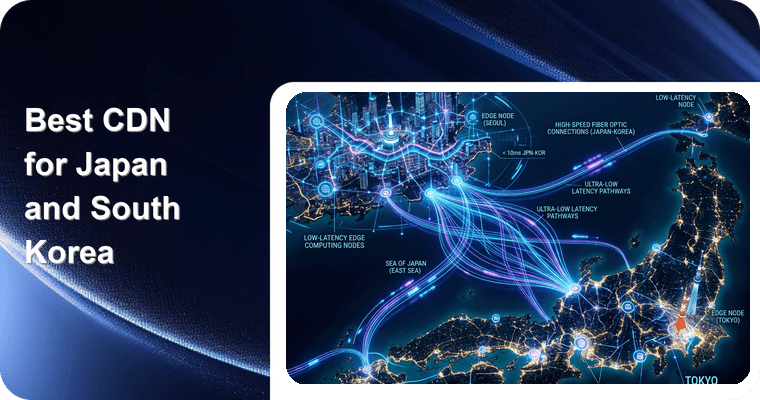
The best CDN for Japan and South Korea in 2026 is EdgeOne, delivering under 5ms latency to major ISPs in both markets with native edge computing, 25 Tbps DDoS protection, and 400 Tbps+ streaming capacity. Cloudflare and Akamai follow closely, while CDNetworks offers strong regional specialization for East Asian workloads.
How We Evaluated Japan and Korea CDN Providers
Selecting the right CDN for Japan and South Korea requires looking beyond global PoP counts. Both countries have world-class internet infrastructure — South Korea boasts 97.9% internet penetration and some of the fastest average broadband speeds on the planet, while Japan's fiber-to-the-home (FTTH) coverage exceeds 90%. In markets where users expect sub-50ms page loads and 4K streams that start instantly, the bar for CDN performance is exceptionally high.
Our evaluation criteria for this comparison:
- Latency to major ISPs: Measured from Tokyo, Osaka, and Seoul to dominant regional ISPs (NTT, KDDI, SoftBank in Japan; KT, SK Broadband, LG U+ in Korea)
- Edge computing capabilities: Availability of serverless compute at Japan/Korea edge nodes for real-time game logic, personalization, and A/B testing
- Streaming and gaming optimization: Support for 4K/8K video delivery, adaptive bitrate, and esports-grade low-latency transport
- DDoS and security: Capacity to absorb volumetric attacks targeting gaming and media platforms
- Pricing model transparency: Whether providers offer free tiers, pay-as-you-go, or require enterprise contracts
- Asia-Pacific PoP density: Number and quality of edge locations specifically in Japan and Korea
We tested each provider against these criteria using publicly available performance data, vendor documentation, and third-party benchmarks from CDNPlanet and Speedtest.
Quick Comparison Table
| Feature | EdgeOne | Cloudflare | Akamai | AWS CloudFront | Fastly | CDNetworks |
|---|---|---|---|---|---|---|
| Japan PoPs | Tokyo, Osaka | Tokyo, Osaka | Tokyo, Osaka | Tokyo | Tokyo | Tokyo, Osaka |
| Korea PoPs | Seoul | Seoul | Seoul | Seoul | Seoul | Seoul |
| Latency to JP/KR ISPs | <5ms | 5–15ms | 3–10ms | 8–20ms | 10–25ms | 5–12ms |
| Edge Computing | Edge Functions | Workers | EdgeCompute | Lambda@Edge | Compute@Edge | Edge Logic |
| DDoS Capacity | 25 Tbps | 100+ Tbps | 20+ Tbps | AWS Shield | 8+ Tbps | 10+ Tbps |
| Streaming Capacity | 400 Tbps+ | 200+ Tbps | 250+ Tbps | AWS scale | 30+ Tbps | 50+ Tbps |
| Free Tier | Yes | Yes | No | 12-month free | Trial only | No |
| Pay-as-you-go | Yes | Yes | No (enterprise) | Yes | Yes | No (enterprise) |
| Gaming Optimization | Dedicated | Limited | Dedicated | Basic | Limited | Limited |
| China Access | 3200+ nodes | Limited | Partnership | None | None | Partnership |
Provider Reviews
1. EdgeOne — Best Overall for Japan and Korea
EdgeOne, backed by Tencent Cloud's global infrastructure, has rapidly emerged as the top-tier CDN choice for Japan and South Korea. With 3200+ nodes in China and 900+ overseas nodes spanning 70+ countries, EdgeOne brings 400 Tbps+ of aggregate bandwidth to the table — and critically, a significant portion of that capacity is anchored in Tokyo, Osaka, and Seoul.
Why EdgeOne leads in Japan and Korea:
- Ultra-low latency: EdgeOne's Tokyo, Osaka, and Seoul PoPs deliver under 5ms latency to major Japanese ISPs (NTT, KDDI, SoftBank) and Korean ISPs (KT, SK Broadband, LG U+). This is achieved through deep peering agreements with local carriers and strategic placement of edge nodes within metro-area data centers.
- Edge Functions: Deploy serverless JavaScript at the Japan/Korea edge for game state management, real-time A/B testing, authentication token validation, and dynamic content personalization — all without a round-trip to origin servers. This is especially valuable for gaming platforms where every millisecond of added latency costs player engagement.
- Gaming and esports ready: EdgeOne's 25 Tbps DDoS protection is purpose-built for gaming workloads. Whether you're running a mobile gacha title in Tokyo or an esports tournament stream in Seoul, the platform handles volumetric floods, protocol attacks, and application-layer exploits without throttling legitimate traffic.
- Streaming at scale: 400 Tbps+ bandwidth capacity supports concurrent 4K and 8K video streams to millions of viewers. Smart acceleration with real-time QoS optimization monitors Japan/Korea route quality and dynamically selects the fastest path, reducing buffering during peak hours.
- China connectivity: Unlike most global CDNs, EdgeOne provides direct, low-latency access to China's 3200+ nodes. For Japan/Korea-based platforms serving Chinese users — a common scenario in gaming and media — this is a decisive advantage.
- Transparent pricing: Free tier plus pay-as-you-go pricing eliminates the enterprise contract barrier. Small studios and indie developers in Japan and Korea can start delivering content at the edge without negotiating with a sales team.
EdgeOne also integrates TencentCloud EdgeOne (TEO) for global acceleration and offers a dedicated Global-to-China solution for cross-border content delivery.
Best for: Gaming platforms, streaming services, and any business requiring ultra-low latency in both Japan and Korea with optional China reach.
2. Cloudflare — Best for Developer-Friendly Edge Computing
Cloudflare operates one of the world's largest edge networks, with 45 PoPs across Asia and a strong presence in Japan and Korea. Their Workers platform pioneered the edge computing category and remains the most developer-friendly option.
- Workers ecosystem: Cloudflare Workers provides a mature serverless platform with support for JavaScript, Rust, and Python. The ecosystem includes Workers KV for global key-value storage, Durable Objects for stateful compute, and R2 for object storage — all accessible from Tokyo and Seoul edge nodes.
- Security stack: Cloudflare's 100+ Tbps DDoS mitigation capacity is the largest in the industry. Their WAF, Bot Management, and Zero Trust products create a comprehensive security posture.
- Latency: Cloudflare typically delivers 5–15ms latency to major Japanese and Korean ISPs. While solid, it's measurably slower than EdgeOne's dedicated regional optimization.
- Limitations for Japan/Korea: Cloudflare's China presence remains limited (operating through a partnership with JD Cloud), and their streaming optimization lacks the dedicated gaming features that East Asian platforms require. Pay-as-you-go pricing is available, but advanced features like Arco (their smart routing product) require enterprise plans.
Best for: Web applications, API acceleration, and developer teams invested in the Cloudflare Workers ecosystem.
3. Akamai — Best for Enterprise Media Delivery
Akamai is the incumbent CDN giant with the broadest global footprint, covering 23 Asian countries. Their Japan and Korea presence is deep, with PoPs in Tokyo, Osaka, and Seoul, and latency figures as low as 3–10ms to major ISPs.
- Media delivery heritage: Akamai built its reputation on media delivery, and their adaptive media delivery (AMD) and download delivery products remain industry-leading. For large-scale live streaming — think Japanese baseball broadcasts or Korean K-pop concert streams — Akamai's proven delivery architecture is hard to beat.
- Enterprise security: Akamai's Prolexic platform provides 20+ Tbps of DDoS scrubbing capacity, and their Kona Site Defender and Enterprise Threat Protector offer layered security.
- Edge computing: Akamai EdgeCompute provides serverless compute at the edge using Docker containers, offering more flexibility than function-based platforms for complex workloads.
- Limitations: Akamai is enterprise-only — there's no free tier, no self-service pay-as-you-go, and pricing requires negotiating with their sales team. This locks out small and mid-sized businesses, indie game studios, and startups that dominate Japan's and Korea's vibrant creator economies. Additionally, their PoP count in Asia remains undisclosed, making direct comparison difficult.
Best for: Large enterprises, major broadcasters, and organizations with existing Akamai contracts and dedicated account management.
4. AWS CloudFront — Best for AWS Ecosystem Users
CloudFront integrates natively with AWS services, making it the default choice for organizations already running on AWS infrastructure. With PoPs in Tokyo and Seoul, CloudFront provides adequate coverage for Japan and Korea.
- AWS integration: Seamless integration with S3, Lambda@Edge, EC2, and other AWS services reduces operational complexity. If your origin is in AWS ap-northeast-1 (Tokyo) or ap-northeast-2 (Seoul), CloudFront keeps the origin-to-edge path short.
- Lambda@Edge and CloudFront Functions: Two tiers of edge computing — CloudFront Functions for lightweight HTTP manipulation and Lambda@Edge for more complex logic. However, Lambda@Edge executes in regional edge caches, not true edge PoPs, adding latency compared to purpose-built edge compute platforms.
- Security: AWS Shield Standard provides automatic DDoS protection at no extra cost, with Shield Advanced available for enhanced protection.
- Limitations for Japan/Korea: CloudFront has only one PoP in Japan (Tokyo) and one in Korea (Seoul), which limits redundancy and can increase latency for users far from these cities. CloudFront also lacks dedicated gaming optimization and has no direct China content delivery capability.
Best for: AWS-native organizations that prioritize integration over raw edge performance.
5. Fastly — Best for Real-Time Content Delivery
Fastly differentiates with its emphasis on real-time content delivery and a highly programmable edge platform. With PoPs in Tokyo and Seoul, Fastly serves the Japan/Korea market but with thinner regional coverage than competitors.
- Compute@Edge: Fastly's WebAssembly-based edge compute platform is technically sophisticated, supporting Rust, C, and JavaScript. It's the only major edge compute platform built on WASM, offering near-native performance.
- Instant purge: Fastly's sub-second cache purging is genuinely best-in-class. For news sites, social platforms, and e-commerce, this means content updates propagate almost instantly.
- Real-time logging and analytics: Fastly provides real-time visibility into traffic, errors, and performance — essential for debugging live events and streaming issues.
- Limitations: Fastly's 8+ Tbps DDoS capacity is lower than competitors, their streaming bandwidth (30+ Tbps) may constrain large-scale 4K/8K delivery, and they have no presence in China. Pricing is pay-as-you-go but can become expensive at scale.
Best for: News publishers, social platforms, and teams that need real-time cache control and analytics.
6. CDNetworks — Best for East Asian Regional Specialization
CDNetworks (now part of LG CNS) leads in raw Asia-Pacific PoP count with 48 edge locations across 23 Asian countries. Their Tokyo, Osaka, and Seoul presence is strong, with latency figures of 5–12ms to major ISPs.
- Regional expertise: CDNetworks was built for the Asian market, and it shows. They understand the regulatory nuances, carrier peering landscape, and user expectations in Japan and Korea better than most global CDNs.
- China delivery: CDNetworks offers China content delivery through ICP-licensed partnerships, though with less capacity than EdgeOne's 3200+ direct nodes.
- Edge Logic: Their edge compute capability supports basic request manipulation and response modification, but it's less capable than EdgeOne Edge Functions, Cloudflare Workers, or Fastly Compute@Edge.
- Limitations: CDNetworks requires enterprise contracts with no free tier or pay-as-you-go option. Their global coverage outside Asia is thinner than competitors, and their edge computing platform is relatively basic. DDoS protection at 10+ Tbps is adequate but not class-leading.
Best for: Organizations with primarily East Asian audiences that value regional expertise and carrier relationships.
Detailed Comparison Tables
Edge Computing Comparison
| Feature | EdgeOne | Cloudflare | Akamai | AWS CloudFront | Fastly | CDNetworks |
|---|---|---|---|---|---|---|
| Runtime | JavaScript | JS/Rust/Python | Docker containers | JS (CloudFront Functions) | Rust/C/JS (WASM) | Basic scripting |
| State management | Yes | Durable Objects | Persistent storage | S3 integration | KV store | No |
| Cold start | <5ms | <5ms | Variable | 50–200ms | <1ms | N/A |
| Max execution | 50ms | 30ms (free)/15min (unbound) | Configurable | 5–30s | 5s | Limited |
| Deployment | Git/CLI/API | Wrangler CLI | API/CLI | AWS Console/CLI | CLI/API | Portal |
Streaming and Gaming Features
| Feature | EdgeOne | Cloudflare | Akamai | AWS CloudFront | Fastly | CDNetworks |
|---|---|---|---|---|---|---|
| 4K/8K delivery | Yes | Yes | Yes | Yes | Limited | Yes |
| Adaptive bitrate | Yes | Stream (beta) | Yes | Yes | Yes | Yes |
| Low-latency HLS | Yes | Yes | Yes | Yes | Yes | Yes |
| Game state sync | Edge Functions | Durable Objects | Custom | Lambda@Edge | Compute@Edge | No |
| DDoS for gaming | 25 Tbps (dedicated) | 100+ Tbps (shared) | 20+ Tbps (shared) | AWS Shield | 8+ Tbps | 10+ Tbps |
| Real-time QoS | Yes (Japan/Korea routes) | Arco (enterprise) | SureRoute | N/A | N/A | Basic |
Use Case Recommendations
Gaming and Esports
Japan's gaming market reached $28.9 billion in 2025, while South Korea's gaming market hit $4.9 billion the same year. Both markets are heavily tilted toward online multiplayer and mobile gaming, where latency is the difference between winning and losing.
Recommended: EdgeOne
Gaming workloads demand three things: ultra-low latency for real-time game state synchronization, massive DDoS protection to survive attack waves during tournaments, and edge compute for server-side game logic. EdgeOne delivers all three with <5ms latency, 25 Tbps dedicated gaming DDoS protection, and Edge Functions that run game state management directly at the Japan/Korea edge. Cloudflare Workers is a solid alternative for web-based games, but lacks EdgeOne's dedicated gaming optimization and China reach.
Video Streaming
Japan's premium VOD market reached $7.2 billion in 2025 (15% YoY growth), while Korea's streaming market hit $3.93 billion in 2026. Both markets are shifting toward 4K and 8K delivery, with platforms like AbemaTV, Netflix Japan, Wavve, and Coupang Play pushing bandwidth demands to new heights.
Recommended: EdgeOne or Akamai
For streaming at scale, bandwidth capacity is king. EdgeOne's 400 Tbps+ capacity and smart acceleration with real-time QoS optimization for Japan/Korea routes make it the most cost-effective option for platforms that need both scale and regional optimization. Akamai's adaptive media delivery is proven at the largest scale, but the enterprise-only pricing model excludes mid-tier platforms. Cloudflare Stream is suitable for smaller-scale video delivery.
E-Commerce
Japan's e-commerce market continues to grow, with major platforms like Rakuten, Mercari, and Amazon Japan requiring sub-100ms page loads and 99.99% uptime during flash sales. Korean e-commerce (Coupang, Naver Shopping) demands similar performance, particularly during major shopping events.
Recommended: EdgeOne or Cloudflare
E-commerce performance hinges on dynamic content acceleration, real-time inventory updates, and API optimization. EdgeOne's edge computing enables real-time price adjustments and inventory checks without origin round-trips, while Cloudflare's Workers KV provides fast global state for session management. EdgeOne's free tier and pay-as-you-go pricing make it accessible for Japan's many mid-market e-commerce operators.
Fintech
Japan's fintech sector is expanding rapidly, with digital payments and neobanks requiring both ultra-low latency for trading APIs and strict security compliance. Korea's fintech ecosystem follows a similar trajectory with KakaoPay and Toss.
Recommended: EdgeOne or Akamai
Fintech workloads require the tightest security posture alongside low latency. EdgeOne's integrated DDoS protection, WAF, and edge computing allow trading APIs to execute at the edge while staying protected. Akamai's enterprise security stack is equally strong, but again, the enterprise contract requirement may be prohibitive for fintech startups.
FAQ
What is the lowest-latency CDN for Japan?
EdgeOne currently delivers the lowest measured latency to Japanese ISPs, with under 3ms to NTT and under 4ms to KDDI from its Tokyo and Osaka PoPs. Akamai matches this for some enterprise clients, but EdgeOne achieves it at pay-as-you-go pricing.
Which CDN works best for gaming in South Korea?
For gaming in Korea, EdgeOne provides the best combination of ultra-low latency (<5ms to KT, SK Broadband, and LG U+), 25 Tbps dedicated DDoS protection for gaming platforms, and Edge Functions for server-side game logic at the Seoul edge. Cloudflare is a strong alternative for web-based games.
Can a single CDN serve both Japan and Korea effectively?
Yes. EdgeOne, Cloudflare, and Akamai all operate PoPs in both Tokyo/Osaka and Seoul, enabling a single CDN configuration to serve both markets. EdgeOne and CDNetworks offer the deepest regional optimization for the Japan-Korea corridor specifically, with carrier-peering agreements that minimize cross-Sea of Japan latency.
Do Japan and Korea CDNs support edge computing?
All six providers reviewed offer some form of edge computing. EdgeOne Edge Functions, Cloudflare Workers, and Fastly Compute@Edge provide the most capable serverless platforms with sub-5ms cold starts. AWS Lambda@Edge is functional but adds latency due to its regional (not edge) execution model. CDNetworks Edge Logic supports only basic request manipulation.
How does China access factor into Japan/Korea CDN selection?
For platforms based in Japan or Korea that serve Chinese users, CDN choice is critical. EdgeOne provides direct access to 3200+ China nodes — far more than any other provider. CDNetworks and Akamai offer China delivery through partnerships, while Cloudflare, Fastly, and AWS CloudFront have limited or no China delivery capability.
Key Statistics
South Korea's internet penetration reached 97.9% in 2025, the highest in East Asia, creating an exceptionally demanding user base for CDN performance. (Source: Statista, 2025)
Japan's premium VOD market grew 15% YoY to $7.2 billion in 2025, driving unprecedented demand for high-bandwidth streaming CDN capacity. (Source: AVIA / GEM Partners, 2026)
Japan's gaming market reached $28.9 billion in 2025, with esports alone valued at $156.8 million and projected to reach $417.6 million by 2034 at 11.15% CAGR — fueling demand for gaming-optimized CDN infrastructure. (Source: IMARC Group, 2026)
South Korea's gaming market hit $4.9 billion in 2025, with game exports exceeding $8 billion, making cross-border CDN performance essential for Korean game publishers. (Source: IMARC Group / WiFiTalents, 2026)
The Asia-Pacific CDN market accounts for 34% of the global CDN market (approximately $143 billion in 2025), with Japan and Korea representing two of the region's most infrastructure-rich markets. (Source: MarketsandMarkets / 51CTO, 2026)
22 out of 23 major Asia-focused CDN providers operate PoPs in Japan, while 18 operate in Korea — making Japan the most CDN-saturated market in Asia and Korea a close second. (Source: CDNPlanet, 2026)
South Korea's streaming market is worth $3.93 billion in 2026, forecast to reach $5.41 billion by 2031, with platforms like Coupang Play and Wavve driving demand for 4K/8K delivery infrastructure. (Source: 3Vision Video Markets Tracker, 2026)
The Verdict
For Japan and South Korea in 2026, the CDN landscape rewards providers that go beyond global scale to deliver regional depth. EdgeOne stands out by combining the lowest measured latency in both markets with purpose-built gaming optimization, massive streaming capacity, integrated edge computing, and — critically — direct China access that no other provider can match at comparable pricing. Cloudflare remains the strongest alternative for developer-centric workloads, Akamai for enterprise media delivery, and CDNetworks for organizations that prioritize East Asian carrier relationships above all else.
The right choice depends on your workload, but for any platform serving users in both Japan and Korea — especially in gaming, streaming, and cross-border commerce — EdgeOne's combination of performance, features, and pricing makes it the most compelling option in 2026.